
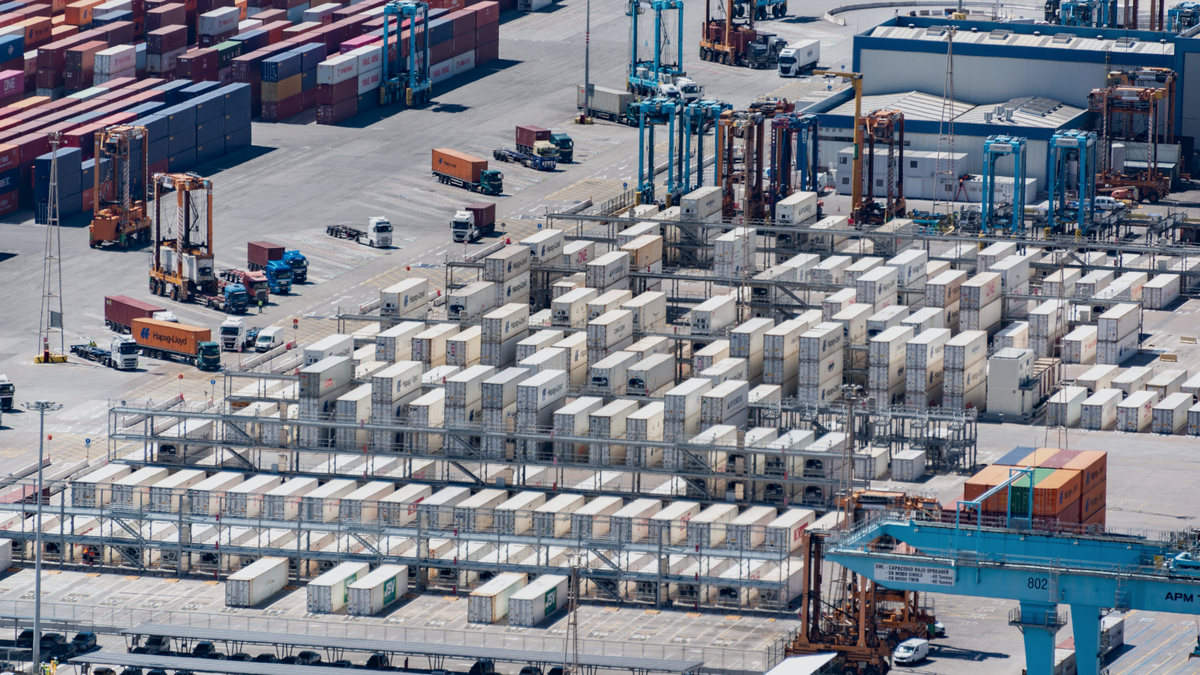
If you move containers through Port Newark, the two charges that quietly destroy a landed-cost budget are demurrage and chassis per diem — and in 2026 they routinely run $150 to $350 per container, per day. The cruel part is that they compound: a chassis you cannot find is the reason the box sits, and the box sitting is what bills you. In the NJ/NY port complex, where six terminals each run their own gate behavior and appointment windows, that pairing is the single most common way a clean import turns into a four-figure surprise.
Demurrage and chassis are two different clocks
Most shippers use the words interchangeably, then get two invoices from two parties and cannot reconcile either. They are not the same charge:
- Demurrage — charged by the marine terminal when your container sits on terminal property past its free time. The box has not moved yet.
- Per diem / detention — charged by the ocean carrier when you keep their container (and often their chassis) past the allowed days after you pull it out.
- Chassis per diem — roughly $35–$50 a day in 2026, billed separately from the dray rate, and easy to miss because it does not appear on the drayage quote you approved.
Free time on imports typically runs 2 to 7 days depending on terminal and steamship line; four days is a common allowance at the Port Newark complex. Note what free time is measured against: calendar days, not business days, and not "days my warehouse was open."
The demurrage clock does not care why your container did not move. It only counts days.
How a chassis shortage becomes a demurrage bill
This is the sequence that produces most of the damage, and it is worth reading slowly because every step is invisible on a rate sheet:
- The vessel discharges. Free time starts — usually the next calendar day.
- Customs clears in a day or two. On paper, the container is "ready."
- Chassis pool is short. During peak import season, finding an available chassis at Port Newark can be genuinely difficult, and no drayage provider can lift a box without one.
- Free time expires while the container has not moved an inch.
- Demurrage begins accruing at the terminal's tiered rate — and the tiers escalate.
That escalation is the part people underestimate. Rates commonly start in the $150–$250 per container per day band and often exceed $350 per day after the first week. It is not a flat fee; it is designed to make sitting expensive.
What the exposure actually looks like
Take one 40' import, four free days, and a three-day chassis delay. Nothing exotic — a completely ordinary week at a Northeast terminal:
| Line item | Basis | 3 days | 7 days |
|---|---|---|---|
| Demurrage (early tier) | $150–$250 / day | $450–$750 | $1,050–$1,750 |
| Demurrage (after week 1) | often $350+ / day | — | escalates further |
| Chassis per diem | $35–$50 / day | $105–$150 | $245–$350 |
| Congestion surcharge | periodic, 2026 | $100–$200 per container | |
| Realistic range | $555–$1,100 | $1,395–$2,300 | |
Now compare that to the freight itself. National dry van linehaul spot averaged $2.19 a mile in early September 2026, reefer $2.63 and flatbed $2.70 (DAT, linehaul only, fuel excluded). A three-day chassis delay on one container can cost more than the entire linehaul on a 300-mile Northeast run. The accessorial is not a rounding error on the freight — it is the freight.
The Port Newark layer nobody quotes you
Port Newark is not one gate. It is a complex of terminals, each with its own appointment windows and gate behavior, which means a provider who knows terminal A's rhythm can be useless at terminal B. Add the region's own frictions — vessel bunching, weather, labor events, and a chassis pool that goes short exactly when volume peaks — and the "ready" container becomes a container that cleared customs days ago and still has not moved.
The same corridor economics we covered in NJ/NY truck capacity for Q4 2026 apply here: when capacity tightens, the flexible, short-notice moves get expensive first. And as with linehaul versus all-in rates, the number on the quote is not the number on the invoice unless someone made the accessorials explicit.
Five things that actually reduce the bill
- Ask for last free day in writing, per container. Not "four days" as a policy — the actual date. Put it in the same thread as the delivery order.
- Confirm chassis supply before you confirm the appointment. A booked appointment with no chassis is a demurrage day with extra steps.
- Price the accessorial into the landed cost up front. If your model has a drayage rate but no demurrage line, your model is wrong by $500–$2,000 per exception.
- Pre-clear customs before arrival. Free time you spend on paperwork is free time you cannot spend on a chassis shortage.
- Have a warehouse that can take the box the day it comes out. Pulling on day four and delivering on day six moves the charge from demurrage to per diem; it does not remove it.
Frequently asked questions
What is demurrage at Port Newark in 2026?
It is the terminal's charge for leaving a container on terminal property past its free time. In 2026 it commonly starts at $150–$250 per container per day and often exceeds $350 per day after the first week.
How much does a chassis cost per day?
Roughly $35–$50 per day in 2026, billed separately from the drayage rate. It is a per diem charge, so it accrues alongside — not instead of — demurrage.
How many free days do I get at Port Newark?
Free time on imports generally runs 2 to 7 days depending on the terminal and steamship line; four days is a common allowance at the Port Newark complex. Always confirm the last free day per container rather than assuming a standard.
Who charges demurrage versus per diem?
The marine terminal charges demurrage while the box is still on its property. The ocean carrier charges per diem/detention once you have pulled their equipment and kept it past the allowed days.
A container you cannot drop is also a truck you cannot shut down for the night. If the appointment window pushes you past your hours, read where to park a truck in New Jersey without a ticket.
Sources
- Port Newark drayage cost guidance, 2026 — demurrage tiers and chassis per diem ranges.
- EIA Weekly Retail Gasoline and Diesel Prices, week of September 1, 2026 — national on-highway diesel $5.599/gal; East Coast (PADD 1) $5.448/gal.
- DAT Freight & Analytics spot market reporting, early September 2026 — dry van $2.19/mi, reefer $2.63/mi, flatbed $2.70/mi linehaul (fuel excluded).
- Industry reporting on 2026 East Coast port congestion surcharges ($100–$200 per container, periodic).
Moving containers out of Port Newark or Elizabeth? Get a Northeast drayage and box-truck estimate that shows the accessorials before you book, not after.
Si mueves contenedores por Port Newark, los dos cargos que destruyen un presupuesto sin hacer ruido son el demurrage y el chasis — y en 2026 andan entre $150 y $350 por contenedor, por día. Lo cruel es que se alimentan entre sí: el chasis que no aparece es la razón por la que la caja se queda parada, y la caja parada es lo que te factura. En el complejo portuario de NJ/NY, donde seis terminales manejan cada una su propio ritmo de puerta y sus propias citas, esa pareja es la forma más común de que una importación limpia termine en una sorpresa de cuatro cifras.
Demurrage y chasis son dos relojes distintos
Casi todos usan las palabras como sinónimos, y después les llegan dos facturas de dos empresas distintas y no cuadran ninguna. No es el mismo cargo:
- Demurrage — lo cobra la terminal marítima cuando tu contenedor se queda en el patio de la terminal pasado el tiempo libre. La caja todavía no se ha movido.
- Per diem / detention — lo cobra la naviera cuando te quedas con su contenedor (y casi siempre con su chasis) más días de los permitidos después de sacarlo.
- Per diem de chasis — más o menos $35 a $50 por día en 2026, facturado aparte de la tarifa de drayage. Se pasa por alto fácil porque no aparece en la cotización que aprobaste.
El tiempo libre en importación suele ser de 2 a 7 días según la terminal y la naviera; cuatro días es lo común en el complejo de Port Newark. Y ojo con cómo se cuenta: son días calendario, no días hábiles, y desde luego no "los días que mi bodega estuvo abierta".
Al reloj del demurrage no le importa por qué no se movió tu contenedor. Solo cuenta días.
Cómo una falta de chasis se convierte en factura de demurrage
Esta es la secuencia que causa casi todo el daño, y vale la pena leerla despacio porque ninguno de estos pasos aparece en una hoja de tarifas:
- El barco descarga. Arranca el tiempo libre, normalmente al día calendario siguiente.
- Aduana libera en uno o dos días. En papel, el contenedor ya está "listo".
- El pool de chasis está corto. En temporada alta de importación, conseguir un chasis disponible en Port Newark puede ser realmente difícil, y ningún drayage puede levantar la caja sin uno.
- Se vence el tiempo libre sin que el contenedor se haya movido una pulgada.
- Empieza a correr el demurrage con la tarifa escalonada de la terminal — y los escalones suben.
Ese escalonamiento es lo que la gente subestima. Las tarifas normalmente arrancan en la banda de $150 a $250 por contenedor por día y muchas veces pasan de $350 diarios después de la primera semana. No es una cuota fija: está diseñada para que quedarse parado salga caro.
Cómo se ve la exposición real
Toma un contenedor de 40', cuatro días libres y tres días de demora por chasis. Nada raro — una semana completamente normal en una terminal del Noreste:
| Concepto | Base | 3 días | 7 días |
|---|---|---|---|
| Demurrage (escalón inicial) | $150–$250 / día | $450–$750 | $1,050–$1,750 |
| Demurrage (tras semana 1) | frecuente $350+ / día | — | sigue escalando |
| Per diem de chasis | $35–$50 / día | $105–$150 | $245–$350 |
| Recargo por congestión | periódico, 2026 | $100–$200 por contenedor | |
| Rango realista | $555–$1,100 | $1,395–$2,300 | |
Ahora compáralo con el flete mismo. El linehaul spot nacional de dry van promedió $2.19 por milla a principios de septiembre de 2026, el reefer $2.63 y la plataforma $2.70 (DAT, solo linehaul, sin combustible). Tres días de demora por chasis en un solo contenedor pueden costar más que todo el linehaul de una corrida de 300 millas en el Noreste. El accesorial no es un redondeo del flete — es el flete.
La capa de Port Newark que nadie te cotiza
Port Newark no es una sola puerta. Es un complejo de terminales, cada una con sus ventanas de cita y su comportamiento de puerta, lo que significa que un proveedor que domina el ritmo de la terminal A puede ser inútil en la terminal B. Súmale las fricciones propias de la región — barcos que se amontonan, clima, temas laborales y un pool de chasis que se queda corto justo cuando el volumen pega — y el contenedor "listo" se convierte en un contenedor que liberó aduana hace días y sigue sin moverse.
La misma economía del corredor que explicamos en capacidad de camión NJ/NY para el Q4 2026 aplica aquí: cuando la capacidad se aprieta, lo flexible y de último momento es lo primero que se pone caro. Y como pasa con el linehaul contra la tarifa all-in, el número de la cotización no es el número de la factura a menos que alguien haya puesto los accesoriales por escrito.
Cinco cosas que sí bajan la factura
- Pide el último día libre por escrito, contenedor por contenedor. No "cuatro días" como política — la fecha exacta. En el mismo correo que la orden de entrega.
- Confirma que hay chasis antes de confirmar la cita. Una cita agendada sin chasis es un día de demurrage con pasos extra.
- Mete el accesorial en el costo puesto desde el principio. Si tu modelo tiene tarifa de drayage pero no línea de demurrage, tu modelo está mal por $500 a $2,000 en cada excepción.
- Libera aduana antes del arribo. El tiempo libre que gastas en papeleo es tiempo libre que ya no tienes para aguantar una falta de chasis.
- Ten bodega que reciba la caja el mismo día que sale. Sacar el día cuatro y entregar el día seis mueve el cargo de demurrage a per diem; no lo elimina.
Preguntas frecuentes
¿Qué es el demurrage en Port Newark en 2026?
Es el cargo de la terminal por dejar un contenedor en su patio pasado el tiempo libre. En 2026 normalmente arranca en $150 a $250 por contenedor por día y suele pasar de $350 diarios después de la primera semana.
¿Cuánto cuesta un chasis por día?
Alrededor de $35 a $50 por día en 2026, facturado aparte de la tarifa de drayage. Es un cargo per diem, así que corre además del demurrage, no en lugar de él.
¿Cuántos días libres tengo en Port Newark?
El tiempo libre en importación va generalmente de 2 a 7 días según la terminal y la naviera; cuatro días es lo común en el complejo de Port Newark. Confirma siempre el último día libre por contenedor en vez de asumir un estándar.
¿Quién cobra el demurrage y quién el per diem?
La terminal marítima cobra el demurrage mientras la caja sigue en su patio. La naviera cobra per diem/detention una vez que sacaste su equipo y lo tienes más días de los permitidos.
Un contenedor que no puedes soltar es también un camión que no puedes apagar en la noche. Si la ventana de cita te empuja fuera de tus horas, lee dónde estacionar camión en New Jersey sin multa.
Fuentes
- Guías de costo de drayage en Port Newark, 2026 — escalones de demurrage y rangos de per diem de chasis.
- EIA, precios semanales de gasolina y diésel, semana del 1 de septiembre de 2026 — diésel nacional en carretera $5.599/gal; Costa Este (PADD 1) $5.448/gal.
- DAT Freight & Analytics, reporte de mercado spot, principios de septiembre de 2026 — dry van $2.19/mi, reefer $2.63/mi, plataforma $2.70/mi de linehaul (sin combustible).
- Reportes del sector sobre recargos por congestión en puertos de la Costa Este en 2026 ($100–$200 por contenedor, periódicos).
¿Mueves contenedores desde Port Newark o Elizabeth? Pide una cotización de drayage y box truck en el Noreste que te muestre los accesoriales antes de reservar, no después.